
The AI PC is Here: Why Your Next Laptop Needs a Brain Transplant
The AI PC is Here: Why Your Next Laptop Needs a Brain Transplant
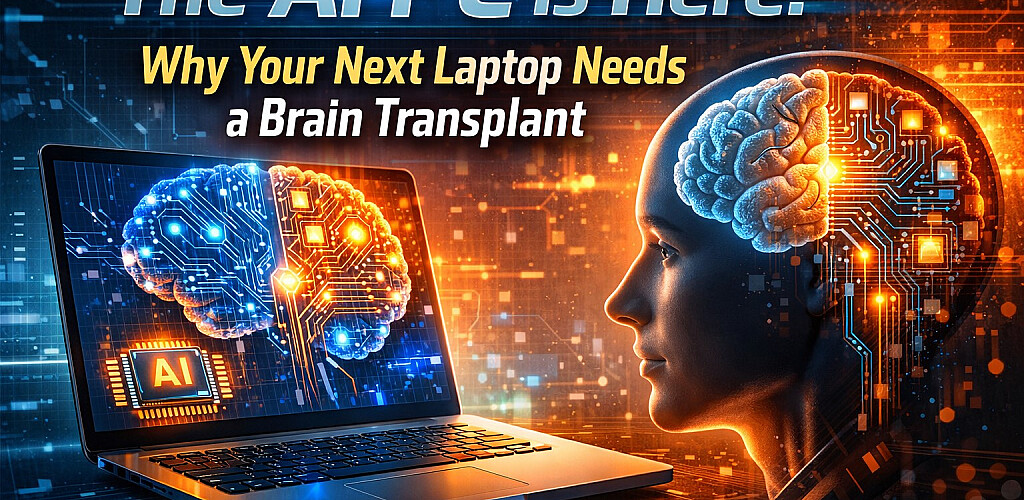
For the last decade, buying a laptop meant focusing on two main components: the CPU (Central Processing Unit) for general speed and the GPU (Graphics Processing Unit) for gaming or creative work. But a new player has entered the chat, and it’s set to redefine how we think about personal computing.
Meet the NPU, or Neural Processing Unit. It is the engine behind the rise of the "AI PC," and it might be the most important hardware upgrade you haven't heard of yet.
What is an NPU, and Why Should You Care?
Think of your computer's brain as a kitchen.
The CPU is your head chef. It can handle any recipe you throw at it, but it can only focus on a few things at once.
The GPU is like a team of specialized line cooks. They are amazing at doing one specific thing, chopping vegetables (rendering graphics) in massive parallel batches.
The NPU is a hyper-specialized machine. Its sole job is to perform the lightning-fast math required for artificial intelligence and machine learning tasks. Specifically, it handles the "inference" part of AI taking a trained model and applying it to new data in real-time.
Why is this a game-changer? Because until now, most AI tasks on your computer (like background blur on Zoom or photo touch-ups) were either sent to the cloud or handled by the CPU/GPU, which drained your battery and slowed down your system.
Three Ways the AI PC Changes Your Daily Life
The shift to on device AI processing, powered by dedicated NPUs (found in new chips like Intel's Core Ultra, AMD's Ryzen 8000 series, and Apple's M-series Neural Engine), unlocks three massive benefits:
1. Privacy and Speed (Goodbye, Cloud)
Currently, when you use an AI tool like ChatGPT or DALL-E, your data usually has to leave your device, travel to a data center, get processed, and come back. With an AI PC, more of these processes will happen locally.
The Result: Imagine asking your computer to find a photo of "the birthday party from last summer" without uploading your entire photo library to a server. It’s faster, and more importantly, your private data stays private.
2. Battery Life That Doesn't Suck
Running AI on a CPU or GPU is inefficient like using a sledgehammer to crack a nut. NPUs are designed to do AI work using a fraction of the power.
The Result: You can keep AI-powered noise cancellation running all day, or have a live video transcript generated in real-time, without watching your battery percentage plummet.
3. Always-On, Real-Time Intelligence
Because the NPU is dedicated and low-power, it can run continuously in the background.
The Result: Think about real-time translation during a video call without lag, or a smart assistant that can detect system issues before they crash your computer. It enables a layer of intelligence that is always present.
The Bottom Line: Do You Need One?
If you are a business professional constantly on Zoom calls, a student who needs live transcription of lectures, or a creative who uses Adobe Lightroom’s AI masking tools, the answer is increasingly yes.
The AI PC isn't just a marketing gimmick; it’s a fundamental shift in architecture. As software developers begin to build apps specifically designed to leverage the NPU (think Microsoft’s upcoming AI Explorer in Windows), the gap between standard laptops and AI-capable laptops will widen significantly.
When you're shopping for your next device, don't just look at the core i5 or i7 sticker. Check the specs for the dedicated NPU or Neural Engine. You're not just buying a computer; you're buying a glimpse into the future of computing.

-medium.jpg)




Comments